
• Qualifying Horary Practitioner (QHP)

    Established 1984

  • Astrological Research

  • Pamela Armstrong

    Pamela Armstrong studied for her MA in Cultural Astronomy at the University of Wales Trinity St David where she covered subjects ranging from Stellar Religions to Sacred Geography, Cosmology, Magic and Divination. Her dissertation explored the skyscapes of early Neolithic Britain. Currently, she is a PhD candidate in the Department of Archaeology and Anthropology at Bournemouth University and is completing her thesis titled ‘A diachronic study of monumentality and cosmology in mid-Holocene southern England and Wales’. Previous papers have been given at Theoretical Archaeology Group conferences, National Astronomy Meetings, the Sophia Graduate Conferences, Bournemouth University SciTech Festival and SEAC. Pamela has published work in the Journal of Skyscape Archaeology, the Journal of Physics: Conference Series and Culture and Cosmos

    Pamela Armstrong’s PhD research has focused on the Cotswold Severn long barrows and their connection to the sun, moon and stars.

    The Cotswold Severn long barrows are the giants of their time. Built over five thousand years ago these monumental mortuary houses brought a radical new architecture to south-western Britain. This research explores the belief systems of the communities who created these sentinels to a lost time. The question at the heart of this project asks whether the Cotswold Severns had a celestial cosmology, one that linked to the sun, moon or stars embedded in their design. The research process involved choosing barrows that are not only extant, but which still have either original stonework or a substantial mound still standing. Sixteen such structures were identified. Fieldwork included an assessment of each barrow’s orientation towards its local horizon. This involved surveying the axis of each monument and where they existed, the chambers and horned forecourts as well. Desk work then involved the application of software to replicate Neolithic skies. The resulting findings indicate that these houses for the dead did connect to the sky. Traditional skyscape archaeology argues that solar and lunar alignments were integral to Neolithic design, but this research indicates that where the people of the long barrows are concerned, the stars were given preference.  

  • Barbara Dunn

    Barbara Dunn holds a PhD in the History of Medicine from the University of Exeter (2023), funded by a doctoral studentship from the Wellcome Trust and an MA (with distinction) in Early Modern History. Barbara is currently preparing a monograph for Springer Nature entitled ‘Medical Astrology in Early Modern England c. 1580-1700: Knowledge and Practice’. Barbara was previously an undergraduate and postgraduate at the London School of Economics, in receipt of a scholarship from the Social Science Research Council. A practising astrologer since the late 1980s, Barbara is author of three astrology books, and is Principal of The Qualifying Horary Practitioner (QHP) a correspondence course teaching the art of Interrogations (horary) and Nativities. A well-known media astrologer for over 25 years, Barbara has written for a variety of UK newspapers and magazines including, inter alia, The Mirror, the Sunday Mirror, the Mail, the Sun, Cosmopolitan, New Woman, Woman’s Own and Best.

  • Darrelyn Gunzburg

    Darrelyn Gunzburg holds a PhD in History of Art (University of Bristol, 2014) and a BA (Hons) in History of Art (Open University, 2007). She taught History of Art at the University of Bristol 2010-2014 and since 2009 has taught on the MA distance learning course run by the Sophia Centre for the Study of Cosmology in Culture at the University of Wales Trinity Saint David where she contributes the visual art historical expression of the sky in culture. Her journal publications include Inside the World of Contemporary Astrology (JSRNC 2019), the reception of sunlight on Madonna dei Tramonti in the Lower Church of Assisi, Italy (Brill, 2019) and as part of the team (with Bernadette Brady and Fabio Silva) investigating the orientation of Cistercian abbey churches in the landscape of Britain and Ireland (published by Cîteaux – Commentarii cistercienses in 2016 and 2021.) She is the editor of The Imagined Sky: Cultural Perspectives (Equinox Publishing Ltd, 2016), and co-editor of Space, Place and Religious Landscapes, Living Mountains (Bloomsbury, 2021). 

  • Chris Mitchell

    Chris Mitchell has been a practising astrologer since the 1990s and specialises in medieval astrology. He is a tutor on the MA Cultural Astronomy and Astrology course at the University of Wales Trinity Saint David and has a PhD from the University of Leicester.

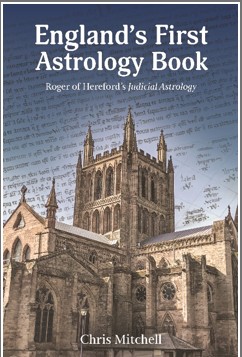
    The twelfth century saw a huge renaissance of astrology in Christian Europe as scholars translated a large number of Arabic texts into Latin. While many scholars of the time focused on translating astrological texts, the techniques also needed to be taught. One scholar, a teacher called Roger in the Cathedral School at Hereford, compiled these techniques into a textbook for the first time for his students, producing what is probably the first astrology textbook in England. This was the topic of Chris’s PhD, which he subsequently turned into a book aimed at contemporary astrologers showcasing these techniques: England’s First Astrology Book.

    PhD thesis: https://doi.org/10.25392/leicester.data.11793636

    Link to book: https://www.amazon.co.uk/Englands-First-Astrology-Book-Herefords/dp/1739809300